
Living in Punta Paitilla, Panama: Complete Guide to the Neighborhood with History and Ocean Views (2026)
Punta Paitilla is Panama City's residential neighborhood with the most history and the most skyline. With tree-lined streets, direct Pacific views, Hospital Paitilla within walking distance, and an established multicultural community, it's an area that combines what few others can offer. This guide tells you exactly what it's like to live here, how much it costs, and who it makes sense for in 2026.
Living in Punta Paitilla, Panama: The Complete Guide to the Neighborhood with History and Ocean Views (2026)
Punta Paitilla isn't Panama City's newest neighborhood. It's not the one with the most modern infrastructure, either, or the highest density of corporate amenities. What it does have, in a combination no other neighborhood can replicate, is this: streets lined with guayacán trees that bloom yellow in summer, residential towers with direct Pacific views, a nationally recognized hospital within walking distance, and a multicultural community that has given the area its character for decades.
Punta Paitilla is the neighborhood Panamanians have always known. The one that existed before Costa del Este was planned, before Punta Pacífica filled up with glass towers. And that history, far from being a disadvantage, gives it a personality newer developments still haven't managed to build.
This guide explains what it's like to live here in 2026: real prices, standout buildings, amenities, limitations, and who it makes the most sense for.
What exactly is Punta Paitilla?
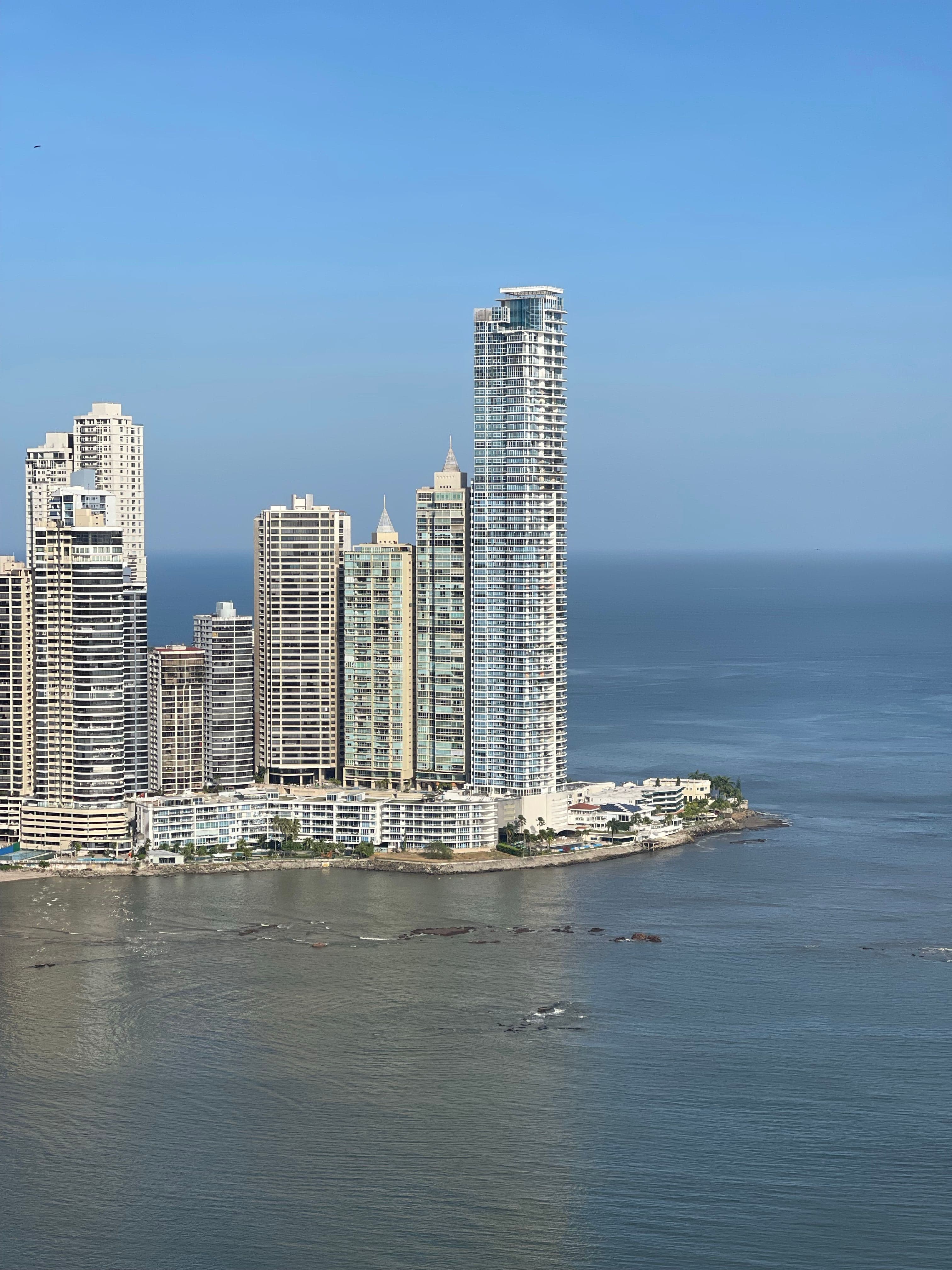
Punta Paitilla is a residential peninsula bordering the Bay of Panama, connecting directly to Avenida Balboa and the Cinta Costera. It's flanked by San Francisco to the north and Punta Pacífica to the south, and its peninsula geography gives it a continuous coastal front that few areas of the city can match.
The neighborhood has a mix of buildings from different eras: from 1970s and '80s towers that were among the first to define the Panamanian skyline, to cutting-edge luxury projects like The Towers Paitilla, Sea Point, and Ocean Front, which have refreshed the area's residential offerings in recent years. That mix of generations gives Punta Paitilla a wider price range than more homogeneous areas like Punta Pacífica or Santa María.
One feature that visually sets it apart from the rest of the city: its residential streets are lined with mature trees, including the guayacán, Panama's national tree, which bursts into a show of yellow blossoms every year, turning Paitilla's streets into one of the country's most unique urban landscapes.
Who does living in Punta Paitilla make sense for?
High-net-worth Panamanian families with roots in the area. Punta Paitilla has an established local community that has lived here for generations. Traditional upper-class Panamanian families have a historical presence in the neighborhood that doesn't exist to the same degree in newer areas. That gives Paitilla a social fabric that some people value enormously, and that can't be built in a new development no matter how many amenities it has.
Residents who prioritize central location above all else. Few neighborhoods in Panama City offer Punta Paitilla's centrality. From here you can reach the financial district, San Francisco, Obarrio, and the Cinta Costera in under ten minutes. That central position, combined with ocean views, is practically unmatched.
Buyers looking for real space for the price. Unlike areas such as Punta Pacífica or Santa María, Punta Paitilla offers apartments with generous square footage—250 m², 329 m², 500 m²—in buildings with history that often have more competitive prices per square meter than new projects in the east. For anyone who wants real space, Paitilla can be the smartest choice in the luxury market.
The city's Jewish and multicultural community. Punta Paitilla has one of the most active Jewish communities in Panama City, with synagogues, kosher restaurants, and services specific to that community. That historic presence is part of the neighborhood's cultural fabric.
Apartment prices in Punta Paitilla: what to expect in 2026
The price range in Punta Paitilla is wider than in most of the city's luxury neighborhoods, precisely because buildings from different generations and amenity levels coexist here.
| Property type | Approximate sale price | Approximate monthly rent |
|---|---|---|
| 2-bed apartment (150–200 m²) in a traditional building | $185,000 – $350,000 | $1,200 – $2,000 |
| 3-bed apartment (250–330 m²) in a modern building | $500,000 – $1,100,000 | $2,500 – $4,500 |
| Penthouse / new-generation luxury units (320–625 m²) | $910,000 – $2,300,000+ | $4,000 – $8,000+ |
| Full floor / ultra premium (500–1,047 m²) | $1,500,000 – $5,000,000+ | Price on request |
The average sale price of apartments in Punta Paitilla is approximately $656,686, according to 2026 data from Compreoalquile, which reflects the weight of new-generation luxury buildings in the active inventory. That said, there are units in older buildings starting at $185,000 for buyers with a more modest budget who want the location and the view without the price of premium projects.
The price per square meter varies enormously: from $1,200/m² in 1980s buildings with fewer amenities to $3,500/m² or more in cutting-edge luxury projects with direct Pacific views. That range is precisely what makes Punta Paitilla a neighborhood with more diverse options than Punta Pacífica, where inventory is more homogeneous and prices skew more uniformly upward.
The most notable buildings in Punta Paitilla in 2026
The Towers Paitilla. This is the flagship project of Punta Paitilla's new generation. Its concave design, inspired by the movement of waves, earned it recognition from CEMEX as residential building of the year. It stands 266 meters tall, and its apartments—329 m², 395 m², and 624 m²—have curved balconies with ocean views from every unit. Prices range from $910,000 to $2,300,000 for the largest units. Amenities include a coffee bar, sushi bar, infinity pool, sky deck, sports courts, VIP cinema, and concierge service.
Sea Point. A luxury residential project with 108 large-format units and 5,000 m² of resort-style social area. Its views of the Pacific and the city skyline are among the widest available in the area. Units range from 177 m² to 427 m², with prices from $454,500 to over $1,100,000.
Ocean Front Paitilla. With 320 m² units starting at $913,400, this is one of the projects with the best space-to-price ratio within Paitilla's luxury segment. Its high-end finishes and modern design position it as a serious alternative to Punta Pacífica's projects at a comparable price per square meter.
The Point. Home to Punta Paitilla's largest residences: 500 m² units starting at $1,740,000. This is the option for anyone looking for the most space available in the neighborhood.
Older-generation buildings. Bayside Tower, Royal Princess, Mar de Plata, Porto Vita, Barlovento, and several others offer apartments from 150 m² to 300 m² at a more accessible price range: $185,000 to $400,000. Condition varies significantly from one building to another, which makes an in-person visit and a review of common-area upkeep essential before committing.
What's daily life like in Punta Paitilla?
Shopping and services. Bal Harbour is the neighborhood's go-to shopping center: it has the Foodie supermarket, Clínica Laboratorio Fernández, and clothing boutiques. Multiplaza Pacific is less than ten minutes away by car. For everyday shopping, supermarket coverage in the immediate area is solid. Ocean Sun Casino, with its poolside bar, is part of the area's entertainment profile.
Hospital Paitilla. Hospital Paitilla is one of Panama's most important reference medical centers, and it's located within the neighborhood. Unlike Punta Pacífica—where Pacífica Salud carries the Johns Hopkins affiliation—Hospital Paitilla is a private Panamanian institution with a long track record and a full range of specialties. For residents with frequent medical needs, having a reference hospital within walking distance has real value that goes beyond the apartment's price.
Cinta Costera and outdoor life. Punta Paitilla connects directly to the Cinta Costera, one of the most underrated assets of living in this area. Parque Nacho Valdés (Parque Paitilla) serves as the neighborhood's green lung, ideal for walking pets, exercising, or just sitting by the sea. For anyone who values everyday access to open spaces along the waterfront, Paitilla is unbeatable in that combination of centrality and coastal frontage.
Mobility. Punta Paitilla's connectivity is one of its biggest advantages. Access to Avenida Balboa lets you move quickly toward the financial district, San Francisco, or Marbella. Uber operates normally. Rush-hour traffic leaving the area is manageable compared to neighborhoods farther from downtown.
Neighborhood character. Unlike Costa del Este—planned and corporate—or Punta Pacífica—more homogeneous and international in profile—Punta Paitilla has a more organic personality. The mix of traditional Panamanian families, expats, executives, and long-term residents gives the neighborhood a more heterogeneous character that, for many, feels more authentic. The streets are walkable, there are human-scale shops, and the feeling of living in a real neighborhood—not an enclave—is part of its appeal.
Punta Paitilla as an investment: the real picture
For an investor evaluating Punta Paitilla as a rental asset, the picture has some important nuances.
Rental demand in the area is active and diverse. The tenant profile ranges from Panamanian professionals and expats to older residents who value proximity to Hospital Paitilla. That demand diversity gives the rental market a certain resilience compared to areas more narrowly focused on a corporate tenant profile.
Gross rental yield in Punta Paitilla is comparable to other luxury areas of the city: between 5% and 6.5% gross annually for units in good condition and well located. Units in older, unrenovated buildings can have a harder time renting at market price, which increases vacancy and reduces effective yield.
Appreciation in Punta Paitilla follows a different profile than Santa María or Costa del Este. The new luxury buildings—The Towers, Sea Point, Ocean Front—have sustained appreciation potential backed by land scarcity and construction quality. Older buildings have a more modest appreciation trajectory that depends heavily on the building's state of upkeep and maintenance fees.
The risk most specific to Punta Paitilla for investors is the spread in quality between buildings. Unlike more homogeneous areas, here the difference between a well-maintained building and one with management problems can be enormous in terms of unit value and ease of renting.
What you should know before moving: the real limitations
Building quality varies significantly. This is the most important point when evaluating Punta Paitilla. An apartment in a building with an active owners' association, maintenance on schedule, and well-kept common areas offers a very different value and quality of life than the building next door with elevator problems, unpaid maintenance fees, or disputes among owners. Before buying or renting, check the condition of the common areas in person and request the most recent owners' association meeting minutes.
Maintenance fees vary enormously. In Punta Paitilla, there are buildings with fees as low as $150 a month and buildings with fees of $800 or more for the largest units in premium projects. That difference needs to factor into the real cost of living or investing here.
Some buildings show signs of aging. Several first- and second-generation buildings in Punta Paitilla are between 30 and 50 years old. Construction quality from that era was solid, but accumulated maintenance may have been uneven. An in-person inspection and a review of maintenance history are essential in these cases.
It's not the easiest neighborhood for walking to everything. Despite being walkable within itself, everyday shopping outside the immediate radius requires a car or Uber. The density of pedestrian-accessible services is lower than in El Cangrejo or San Francisco.
Punta Paitilla vs. Punta Pacífica: when to choose each one
| If you're looking for... | Punta Paitilla | Punta Pacífica |
|---|---|---|
| Entry price | More accessible, starting at $185,000 | Starting at $235,000, more uniformly upscale |
| Space per unit | Generous square footage in traditional buildings | Variable square footage, many compact units |
| Top-tier private healthcare | Hospital Paitilla (national reference center) | Pacífica Salud — Johns Hopkins (first in Latin America with JCI accreditation) |
| Neighborhood character | Organic, multicultural, with history | More homogeneous, international corporate profile |
| Tree-lined streets and parks | Yes, Parque Paitilla and guayacán trees | Less greenery in the immediate area |
| New luxury buildings | Yes, The Towers, Sea Point, Ocean Front | Yes, JW Marriott, Ocean Reef, Grand Tower |
| Consistency of quality across buildings | Variable — requires more due diligence | More uniform, less variation in quality |
Frequently asked questions about living in Punta Paitilla
How much does it cost to live in Punta Paitilla, Panama?
Apartments for sale range from $185,000 for two-bedroom units in traditional buildings to over $5,000,000 for high-end full floors. The average active market price in 2026 is approximately $656,686, reflecting the weight of premium projects in the inventory. For rent, two-bedroom apartments in modern buildings range from $1,200 to $2,000 a month, while new-generation luxury units can exceed $4,000 or $5,000 a month.
Is Punta Paitilla safe to live in?
Yes. It's one of the quietest residential areas in Panama City. Most buildings have 24-hour private security, controlled access, and perimeter surveillance. The neighborhood's strongly residential profile and the presence of established communities contribute to its calm.
What's the difference between Punta Paitilla and Paitilla?
The terms are used interchangeably in the Panamanian real estate market. "Punta Paitilla" technically refers to the tip of the peninsula, while "Paitilla" is the broader name covering the whole neighborhood. In practice, both terms describe the same area for real estate search and evaluation purposes.
Is it worth buying in an older building in Punta Paitilla?
It can be a real opportunity if the building is well maintained and the owners' association is active. The price per square meter can be significantly lower than in new projects, with generous square footage that no longer exists in new inventory. Due diligence is essential: visit the building in person, check the condition of the common areas, request the latest owners' association meeting minutes, and verify there are no pending special assessments or debts to maintenance vendors.
Which building is best in Punta Paitilla?
It depends on your budget and goal. For the highest level of luxury and amenities: The Towers Paitilla. For a good space-to-price ratio in the premium segment: Ocean Front Paitilla or Sea Point. For a more accessible entry point in the neighborhood with generous square footage: buildings like Royal Princess, Mar de Plata, or Barlovento, as long as the maintenance condition is verified beforehand.
Punta Paitilla: the neighborhood that doesn't need to reinvent itself
Punta Paitilla doesn't compete with Costa del Este on corporate urban planning, or with Santa María on private-club exclusivity. It competes on what it has that other areas can't replicate: decades of history, streets lined with trees that bloom yellow, direct Pacific views from the heart of the city, and a community that has chosen to live here for generations.
For anyone looking for a neighborhood with its own character, real centrality, and options ranging from accessible luxury to the most exclusive, Punta Paitilla remains one of the strongest choices in the Panamanian real estate market. Due diligence per building is heavier here than in more homogeneous areas, but those who do it right find a value that new developments are still trying to build.