
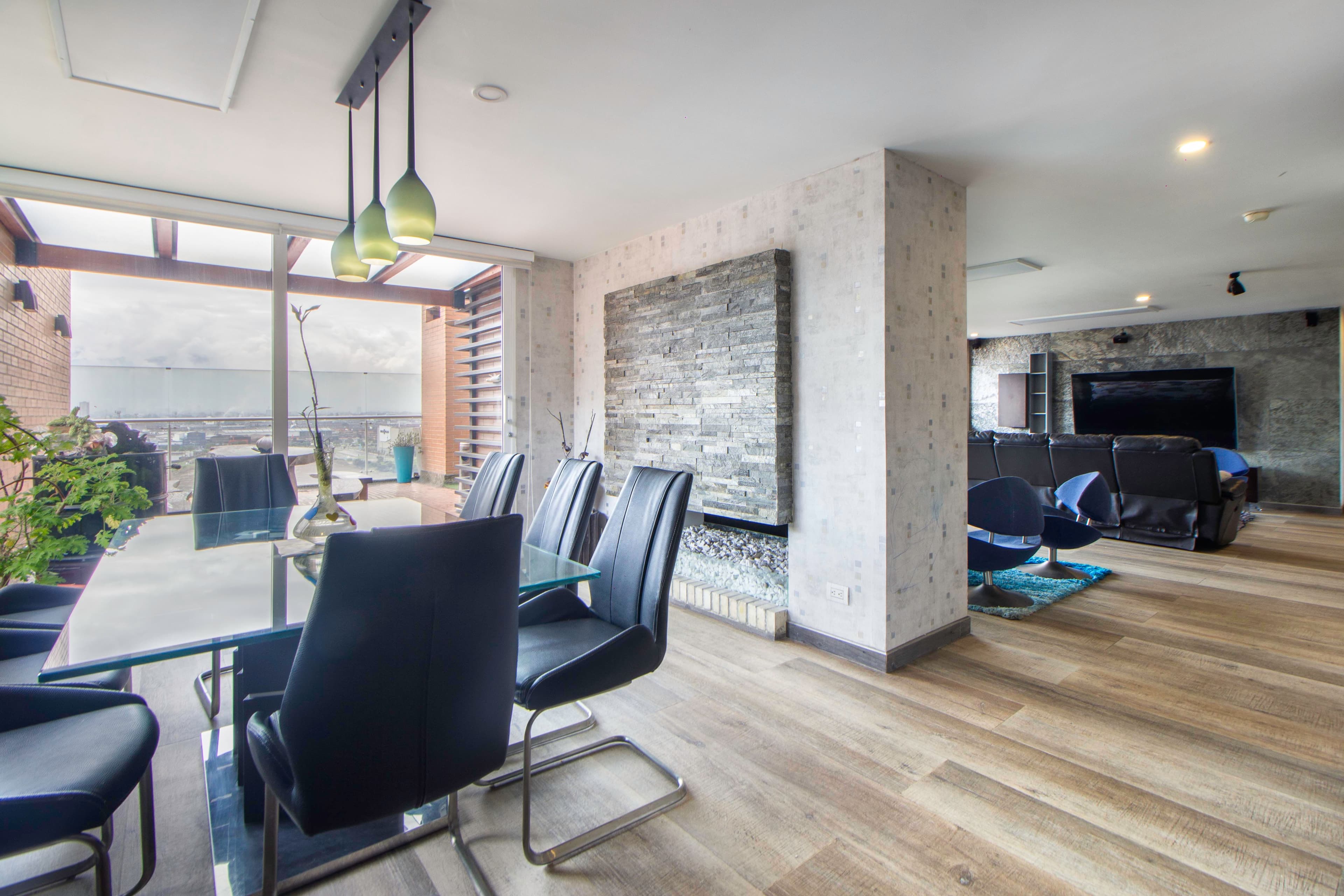
Living in a Penthouse vs. a Standard Apartment in Panama: The Real Differences (2026)
Is it worth paying the penthouse premium in Panama? This guide compares the real differences between living in a penthouse and a standard apartment: price per square meter, maintenance, temperature, views, privacy, resale, and the factors most people don't consider before deciding.
Living in a Penthouse vs. a Standard Apartment in Panama: The Real Differences in 2026
The penthouse has a mystique no other type of property has. The top floor, the private terrace, the unobstructed views, the feeling of being above everything. For many buyers in Panama City, that mystique turns the penthouse into the final destination of a real estate journey: the apartment that comes after all the others.
But mystique doesn't pay the bills or cool down a sweltering terrace. Between the penthouse we imagine and the penthouse we actually live in, there are concrete differences — in price, temperature, maintenance, privacy, and resale — worth understanding before signing. This guide examines them without filters.
The price difference: how much the premium really costs
In Panama City, a penthouse isn't simply the most expensive apartment in the building. It's the one that departs most disproportionately from the rest of the building's price per square meter. That disproportion is the first real difference you should know about.
Generally speaking, the price per square meter of a penthouse in Panama City runs 20% to 60% above the price per square meter of a standard apartment in the same building. That difference reflects several compounding factors: the higher floor, the private terrace, the premium finishes often included in penthouses, the exclusivity of being the only or one of the few units on that level, and the specific demand from buyers who want exactly that.
| Unit type | Typical price/sqm (established area) | Typical price/sqm (premium area) |
|---|---|---|
| Standard mid-floor apartment | $1,800 – $2,400 | $2,500 – $3,500 |
| High-floor apartment (not a PH) | $2,000 – $2,700 | $2,800 – $3,800 |
| Penthouse | $2,500 – $4,000+ | $4,000 – $8,000+ |
What that price differential buys — and what it doesn't buy — is exactly what the rest of this guide examines.
The view: reason number one, and its nuances
The view is the strongest argument for a penthouse, and in Panama City, it can be genuinely spectacular. The Panamanian skyline, the Pacific, the entrance to the Canal, the Bridge of the Americas, the hills of Ancón and Camino de Cruces in the background: from the upper floors of the city's towers, you can see all of it at once, in 360 degrees if the terrace allows it.
But there are nuances worth naming before the view becomes the only decision criterion:
The view is guaranteed in the right direction, not in every direction. A penthouse in a tower that has an even taller tower in front of it can have obstructed views in the direction that matters most. Before buying, visit the unit at different times of day and verify exactly what's visible from every point on the terrace and from inside.
The view can change. A vacant lot across from your terrace can turn into a taller tower in three years. In Panama City, where construction is constant, checking the status of adjacent lots and the applicable height regulations is just as important as appreciating the current view.
The view from the terrace isn't the same as the view from inside. In many penthouses, the most impressive views are only visible from the terrace, not from the living room or bedrooms. If you spend most of your time at home indoors — like almost everyone — the view you see in your everyday life may be more modest than the terrace suggests.
Temperature: the factor nobody mentions in the brochure
This is the aspect of living in a penthouse in Panama that most often surprises buyers after moving in. Panama's tropical climate means the top floor of a building gets direct sun on the roof during the hottest hours of the day. That can translate into indoor temperatures significantly higher than those on the building's middle floors.
How big a problem this is depends on three factors: the roof's thermal insulation (which varies a lot depending on the building's construction and era), the terrace and windows' orientation relative to the sun, and the capacity of the air-conditioning systems to offset that extra heat load.
In the best modern penthouses — with well-insulated roofing, double-glazed windows, and HVAC systems sized for the top floor — the problem is solved, but at a cost: the electricity bill for a penthouse in Panama can be noticeably higher than for an equivalent standard apartment. The air conditioners work harder to maintain the same temperature.
In older penthouses or ones with less investment in insulation, the problem can be severe. Some penthouse owners in 1990s or 2000s-era buildings in Panama City describe terraces that are practically unusable between 11 a.m. and 4 p.m. during the dry season. Visit the penthouse you're interested in during those hours before deciding.
The terrace: the big promise and the big responsibility
The private terrace is the penthouse's signature feature. And it can be genuinely transformative: your own outdoor space within an urban apartment, where you can have breakfast, host friends, exercise, or simply sit with the Pacific in front of you. No standard apartment has that.
But the terrace is also a responsibility many buyers underestimate:
Terrace maintenance. The terrace is permanently exposed to Panama's sun, rain, humidity, and salinity. The terrace flooring, outdoor furniture, plants, waterproofing, and any structural elements require more frequent and intensive maintenance than indoor spaces. In Panama, where rain can be very intense for six months, a terrace with drainage or waterproofing problems can cause leaks that affect the floor immediately below.
Who's responsible for the terrace? In some buildings, penthouse terraces are private property of the unit; in others, they're common areas under exclusive use. That distinction has important implications for who's responsible for maintenance and who pays for repairs. Check this point in the building's condominium bylaws before buying.
A square meter of terrace is worth less than a square meter of built space. In a penthouse's price, terrace square meters are generally valued at 30% to 60% of the value of a built square meter. That matters for calculating price per square meter: a penthouse with 200 sqm of built space plus 150 sqm of terrace doesn't have the same utility as 350 sqm of interior space, even if the price approaches that sum.
Privacy: a real penthouse advantage
One penthouse advantage few guides mention explicitly: privacy. Since it's generally the only unit, or one of very few, on the top floor, neighbor traffic in the immediate hallway is minimal or nonexistent. There's no one living above you. Noises coming from the floor above — footsteps, furniture being moved, kids running around — don't exist.
In buildings with a high density of units per floor, that privacy can be one of the most valued factors for anyone who's lived on a middle floor and knows exactly what the upstairs neighbor's noises mean.
The flip side is that in some penthouses, noise can come from the roof: the building's HVAC systems, machinery equipment, water tanks, or electrical systems located on the building's top level. Before buying, verify exactly what's on the level above the penthouse and whether it generates noise or noticeable vibrations in the unit.
Building maintenance: what a penthouse pays extra
In most Panamanian buildings under condominium regime, the monthly maintenance fee is calculated in proportion to each unit's participation share — which generally reflects the property's size. A 250 sqm penthouse in a building pays a significantly higher maintenance fee than a 90 sqm apartment in the same building.
That difference can be substantial. If the building's average maintenance fee is $200 a month per standard unit, the penthouse might pay $400 or $500 a month depending on its share. That extra monthly expense should always be included in calculating the real cost of living in or investing in a penthouse.
Resale: the building's narrowest market
The penthouse has the building's highest price and its narrowest buyer pool. That has concrete implications if you ever need to sell:
A standard two-bedroom apartment might appeal to families, young professionals, couples, rental investors, and rotating expats. A $1,500,000 penthouse appeals to a significantly smaller universe of buyers. That narrow market can translate into longer time on market when you decide to sell.
It doesn't mean penthouses don't sell or don't appreciate. It means the time to find the right buyer can be longer, and the asset's liquidity is lower than that of a standard unit in the same building. For someone who might need to sell quickly, that lack of liquidity is a real risk factor.
Investing for rental: the penthouse as an income asset
Does it make sense to buy a penthouse as a rental investment in Panama? The answer depends on which market segment you're targeting.
Monthly rent for a penthouse in Panama City can range from $2,500 a month for more modest units in non-premium areas to $8,000 or more for large-format penthouses with Pacific views in Punta Paitilla or Avenida Balboa. That rental range is real, and there's a market of executive tenants, high-income expats, and companies looking for exactly that product.
The problem for investors is that this market is narrow, and vacancy can last longer than for standard units. While a well-priced two-bedroom apartment in Obarrio can rent out in two to four weeks, a $5,000-a-month penthouse can take one to three months to find the right tenant. That vacancy period is costly when the rental price is high.
In terms of yield, penthouses generally have below-average gross rental returns, precisely because the purchase price grows proportionally more than the rent that can be charged. An investor prioritizing yield should look at one- or two-bedroom apartments in high-demand areas rather than penthouses.
What a penthouse offers that no standard apartment can give
With all the limitations laid out, there are things only a penthouse can offer that, for certain buyer profiles, have a value that outweighs any cost-benefit calculation:
Private outdoor space. In a tropical city where the outdoors is part of everyday life, having a private terrace of 100 or 200 square meters that only you use is something no standard apartment can replicate. That's the space where breakfast happens, where friends are hosted at night, where you watch the Pacific sunrise without anyone seeing you from the apartment above.
The feeling of being at the top. There's a real emotional component to living on a building's highest floor that investment guides tend to underestimate. For those who value that feeling — the height, the unobstructed views, the quiet of the top floor — it's hard to put a price on and hard to replace with any standard apartment.
Customization. Penthouses in Panama City tend to have more flexible layouts than standard apartments, where the terrace space can be integrated with the interior through screens, pergolas, or vertical gardens. That possibility for customizing the space is broader than in conventional units.
The right decision for your profile
| Profile | Penthouse or standard apartment? | Why |
|---|---|---|
| Buying to live in, you value outdoor space | A penthouse can make sense | The terrace adds real quality of life if used frequently |
| Investing for rental, you prioritize yield | Standard apartment | Higher yield, lower vacancy, broader tenant market |
| Buying to resell short-term | Standard apartment | More liquid market, shorter time to sell |
| You need maximum privacy | Penthouse | No neighbors above, less hallway traffic |
| Budget stretched to the max | Standard apartment | Same building, lower price/sqm, lower monthly maintenance |
| You value the view more than interior space | High floor, non-PH | Similar view, without the private-terrace premium or its costs |
The alternative few consider: a high floor that isn't the penthouse
There's a middle option many buyers don't consider because they're stuck choosing between the penthouse and the standard apartment: an apartment on a high floor that isn't the top one. In a 30-story building, a unit on the 25th floor has views comparable to the penthouse on the 30th, pays a noticeably lower price per square meter, doesn't have the roof's temperature problems or the terrace maintenance responsibilities, and does have a neighbor above but with the advantage that neighbor doesn't generate any more noise than any other floor in the building.
For those who want penthouse views without the full premium or the extra costs, a high-but-not-top floor is often the smartest option in the building. It's one of the best price-to-quality ratios available in Panama's upper-tier market.
Frequently asked questions about penthouses in Panama
How much does a penthouse cost in Panama City in 2026?
The range is very wide: from $350,000 for more modest penthouses in non-premium areas to more than $5,000,000 for large-format units in Punta Paitilla, Avenida Balboa, or Punta Pacífica. The market's most active range in 2026 is between $500,000 and $2,000,000, where most transactions in this segment are concentrated.
Do penthouses appreciate more than standard apartments in Panama?
Not necessarily in any systematic way. Appreciation depends mainly on the area and the building, not the floor. A penthouse in a building with maintenance problems can appreciate less than a standard apartment in a well-managed building in the same area. What does tend to happen is that a penthouse's premium over the building's standard price holds or widens over time in established buildings in premium areas.
Is it harder to rent out a penthouse than a standard apartment?
Yes, in terms of the time it takes to find the right tenant. The tenant pool for a $4,000 or $5,000-a-month penthouse is considerably narrower than for a $1,500 apartment. That can translate into longer vacancy periods between leases, which reduces the investment's effective return.
What should I check before buying a penthouse in Panama?
Visit during peak-heat hours (11 a.m.–3 p.m.) to assess indoor temperature. Check the roof's insulation. Ask for the last three months' electricity bills to get the real air-conditioning cost. Review the condominium bylaws to find out who's responsible for terrace maintenance. Check exactly what's on the level above the penthouse (machinery, tanks, equipment). And check the status of adjacent lots to assess whether the view could be obstructed in the future.
Is it worth paying the penthouse premium?
For someone who genuinely values the private terrace, top-floor privacy, and unobstructed views as an active part of their everyday lifestyle: yes. For someone buying mainly for prestige or the aspirational value of a penthouse without really using those features: probably not. A penthouse has real value for those who actually live what it offers. For those who won't use the terrace, the same budget goes further on a bigger apartment in a better area, or on a high-floor unit without the top level's full premium.
The right penthouse exists: knowing what you're looking for is half the work
Panama City has some of the most spectacular penthouses in Latin America: 500 sqm units with a terrace facing the Pacific at The Towers Paitilla, full floors in Punta Pacífica with Canal views, terraces with a private infinity pool on Avenida Balboa. Those products exist, and for the right buyer, they're hard to beat in any other city in the region.
It's the buyer's job to be honest about whether their lifestyle justifies that premium. If you spend most of your time at home working, relaxing indoors, and only stepping outside at night, a well-oriented high-floor apartment can give you 80% of the penthouse experience at 60% of the cost. If you're the type who has breakfast on the terrace every day, hosts friends outdoors every weekend, and values outdoor space as another room in the house, the penthouse is exactly what you're looking for.